
Defining Hate Speech at the APPGM-RRH Roundtable
14 April 2026, The Chow Kit - An Ormond Hotel, Kuala Lumpur

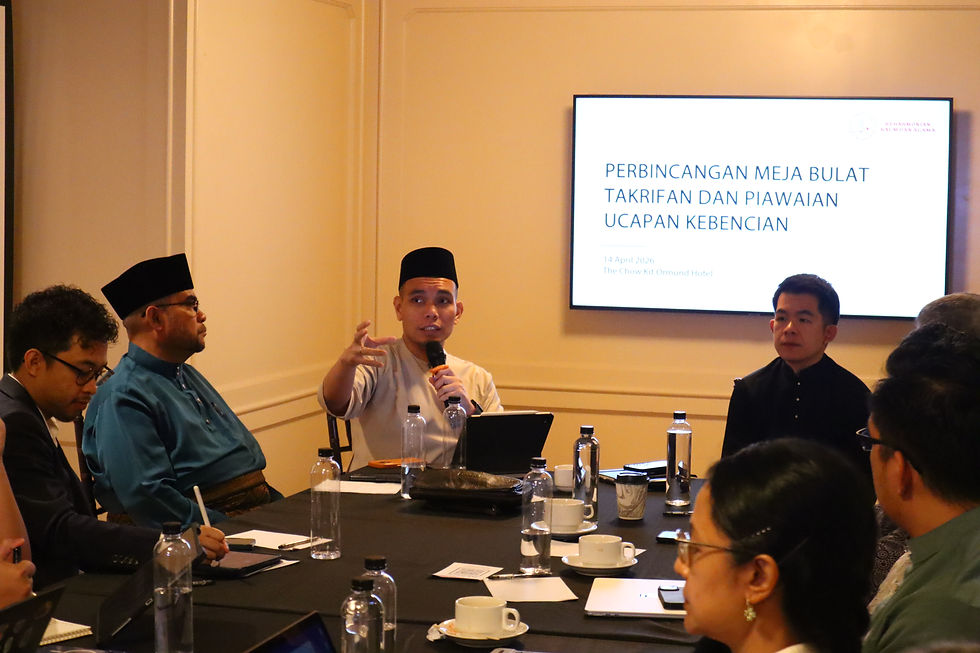
On 14 April 2026, the Malaysian Cross-Party Parliamentary Group on Racial and Religious Harmony (APPGM-RRH) convened a roundtable discussion on the definition and criminal thresholds for hate speech in Malaysia. The session brought together parliamentarians, civil society organisations, academics, legal practitioners, faith-based organisations, and a representative from Meta. AOD Malaysia serves as the Secretariat to the APPGM and facilitated the discussion.
Chaired by YB Tuan Syahredzan Johan, Member of Parliament for Bangi, the roundtable was the second round of consultation following an earlier exchange of written submissions from stakeholders in 2025. Senator Datuk Seri Dr. Mujahid Yusof Rawa, YB Dr. Hajah Halimah Ali, and YB Dato' Sri Saifuddin Abdullah were also present.
Why this matters
Hate speech is regulated in Malaysia under several laws, including the Sedition Act 1948, Section 298 of the Penal Code, the Communications and Multimedia Act 1998, and the Online Safety Act 2025. None of these statutes provide a clear, shared definition of hate speech, and the term "3R" (Race, Religion, Royalty) is often invoked in enforcement without a structured framework behind it. APPGM-RRH is working towards an operational guidance document that helps government agencies interpret existing laws more consistently. The document is not intended to amend any existing legislation.
Discussion 1: What should hate speech mean?
The first session opened with two questions. What terms should be included in a working definition of hate speech, and who or what should be protected. AOD's Jason Wee presented a summary of written submissions, which surfaced two broad approaches. The first centres on human dignity. The second centres on public order. On the question of 3R specifically, participants were divided between a protectionist view that emphasises the safeguarding of institutions and the Federal Constitution, and a rights-based view that argues for narrowly defined restrictions and rejects blanket criminalisation.
Several themes emerged across the discussion. Many participants argued that the focus of protection should be the individual rather than institutions, and that international human rights standards offer a workable baseline. Others emphasised that any definition must reflect Malaysia's specific social context, including the layered overlap between political, ethnic, and policy debates that can easily be reframed as 3R issues. The role of social media in amplifying and monetising hateful content, including coordinated campaigns targeting refugee and migrant communities, came up repeatedly. So did the question of how to assess intent, harm, and the historical context of laws that were drafted in very different eras.
Senator Mujahid framed the underlying choice as one between a punitive anti-hate-speech approach and a preventive national-harmony approach, and argued that the latter offers a broader and more productive frame for the Group’s work. YB Saifuddin echoed this, saying he viewed hate speech primarily as an obstacle to national harmony, and that protection should sit with the individual, grounded in the principles of maqasid syariah. YB Halimah reiterated that the Group’s remit is racial and religious harmony, and stressed the need to build a culture of coexistence rather than only a punitive regime.
Discussion 2: Where should the threshold sit?
The second session focused on the threshold at which speech should be treated as a criminal offence. Three models were on the table: the six-factor Rabat Plan of Action used at the UN level, a two-arm test based on operation and intent, and a model grounded in intent and historical context drawn from the Malaysian setting.
Participants broadly accepted the Rabat Plan as a useful starting point, while flagging that it requires adaptation. The Plan's six factors are context, the speaker, intent, content and form, the extent of the speech act, and the likelihood of harm. Several participants stressed that these factors must be triangulated rather than applied in isolation, and that severity of impact, not volume, should be the primary determinant of where the criminal threshold sits. The role of platform algorithms in driving severity was raised by participants from civil society and from Meta, with agreement that platform accountability needs to sit alongside speaker accountability.
A recurring concern was institutional readiness. Several participants asked who will interpret severity and apply any new framework, and whether enforcement agencies have the consistency and training to do so without bias. Others raised the risk of the guidance being developed in isolation from the work of bodies such as the Ministry of National Unity, the Malaysia Media Council, and NUCC. The Rukun Negara was proposed as the local normative anchor for adapting the Rabat Plan to the Malaysian context.
Where this goes next
Closing the roundtable, YB Syahredzan thanked participants for the range of inputs and insights shared, and confirmed that these would be consolidated into the guidance document the APPGM-RRH is developing. Once finalised, the document will be submitted to relevant ministries and agencies, can be tabled and recorded in Parliament through Hansard, and may be cited in court decisions and wider legal discussion.
APPGM-RRH’s working position is that the guidance is not a substitute for legislative reform, but a practical tool to help existing laws be applied with greater fairness and consistency. As YB Syahredzan acknowledged, full consensus on the definition of hate speech is unlikely in a single sitting. The value of the roundtable is in surfacing the range of positions openly, so that whatever guidance emerges carries a sense of shared ownership among the stakeholders who helped shape it.


Comments